Got a pair? Find out what it is and when it was made.
A brief history
FootJoy dates itself to 1857, when Frederick Packard left his father’s boot business and started his own firm in Brockton, Massachusetts. Brockton made more shoes than anywhere else in America at the time, and Packard’s company was one of dozens in the town. It later became the Field and Flint Company, and for its first fifty years it made ordinary shoes for ordinary customers.
Golf arrived with Perley Flint, a Harvard graduate and keen golfer who joined around 1910 and began working on soles and spike patterns for the course. In 1923 the company ran a competition among its staff to name the new line. A woman from the stitching room won the fifty-dollar prize with “Foot-Joy”, though nobody kept a note of her name. Walter Hagen’s American team wore the shoes at the first Ryder Cup in 1927, and the following year Johnny Farrell wore them to beat Bobby Jones in a playoff for the US Open.
The shoes most people mean when they say “Classics” come from the Tarlow years. Bill and Dick Tarlow bought Field and Flint in 1957 and made golf the focus of the business, with every pair made at their factory in Brockton. Each pair was Goodyear welted, which means the calfskin upper, a cork and Poron footbed and a leather sole were stitched together, so the sole could be replaced when it wore through. They came in ten widths from AAA to EEEE and on several lasts, so most golfers could get something close to a made-to-measure fit off the shelf. The leather softened and took the shape of the foot over a few seasons. The downside was weight, about three pounds a pair, and a sole that let in water on a wet morning.
For a long time that didn’t matter. By 1985 the Brockton plant employed more than 260 people and made nearly 400,000 pairs a year. That same year Acushnet, which already owned Titleist, bought FootJoy from General Mills for about $57 million. Around then the word “Classics” started appearing on the insoles.
From the late 1980s, factories in Asia began making golf shoes with glued soles. They were lighter and drier than anything welted and much cheaper to produce, and golfers switched to them. FootJoy spent the next twenty years trying to keep the Classics going. It subsidised the price to shops, brought out the lighter Lites and the more water-resistant Dry and Dry Premiere, and in 2004 spent more than $1 million on new equipment for the factory. The decline carried on regardless. By 2009 the plant was making fewer than 50,000 pairs a year, and a new pair cost around $345.
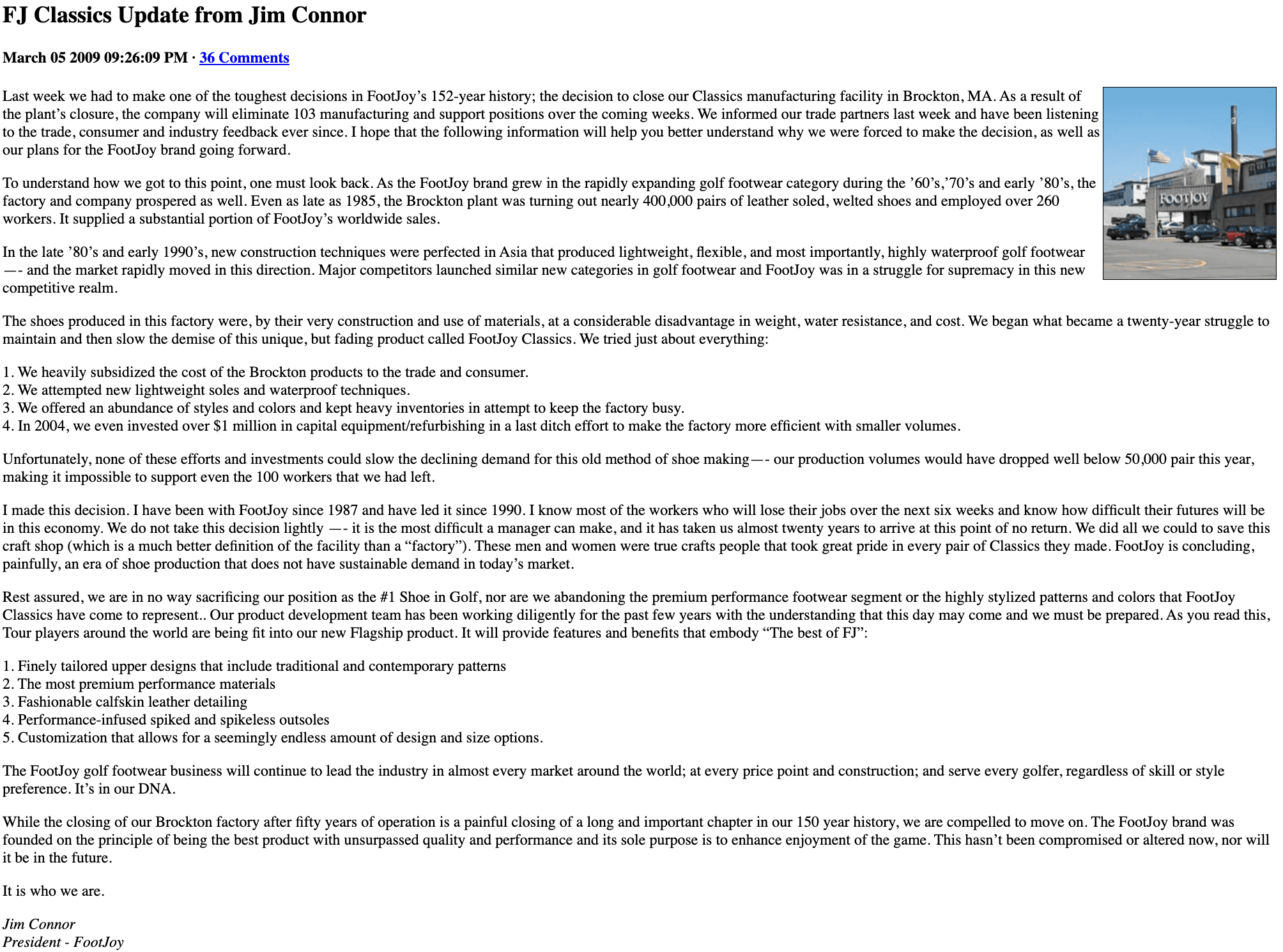
On 26 February 2009 FootJoy announced it would close the factory within six weeks, with the loss of 103 jobs. It was the last shoe factory left in Brockton. A week later Jim Connor, who had run FootJoy since 1990, published a letter explaining the decision. He called the plant a craft shop rather than a factory and said its workers “took great pride in every pair of Classics they made”. The letter is reproduced below.
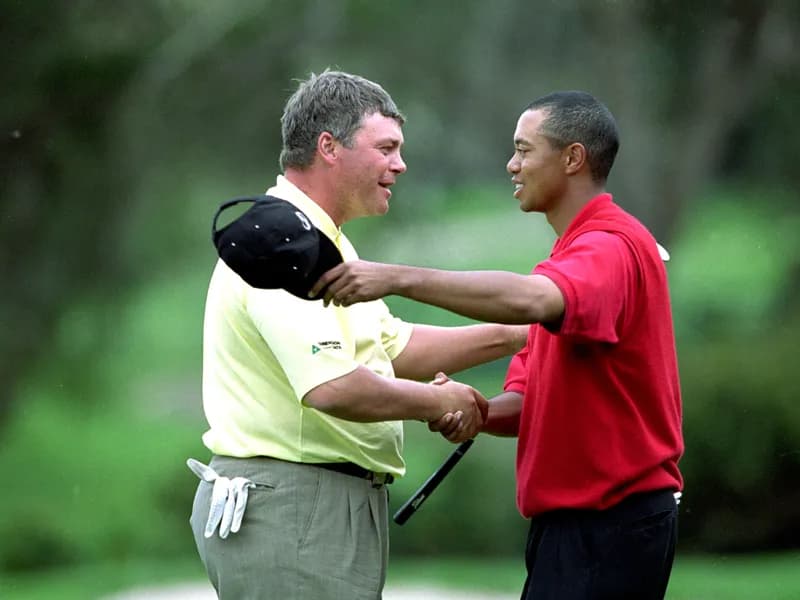
Clarke and Woods. The two shake hands at the end of the match.
Credit to come
“If I’m playing for a million dollars, I want to look like a million dollars.”
Darren Clarke, 2000
When Darren Clarke played Tiger Woods in the final of the 2000 World Golf Championships Match Play, he asked for a pair of FootJoy’s alligator Classics to be delivered to his hotel the night before. Asked why he would risk breaking in new shoes in the biggest round of his life.
Source: Golf Digest
The end of an era